
Machinist Red Seal exam guide: format, pass mark and how to prepare
Use the official allocation to balance conventional machines, CNC, benchwork, grinding and the calculations that connect setup choices to the finished part.
The Machinist Red Seal exam is a multiple-choice exam with 135 questions, four answer choices per question, a four-hour time limit and a 70% pass mark. Provincial and territorial apprenticeship authorities register candidates and administer the exam; in Ontario the trade is called General Machinist (429A).
Sources: official exam breakdown and Red Seal exam preparation guide, checked October 12, 2026.
Machinist practice test: 25 free questions, online or PDF · Machinist Red Seal exam prep app · Prep options compared
Ontario 429A · General Machinist
Looking for machinist Red Seal practice tests, general machinist exam prep or CNC study questions? The Machinist trade includes conventional lathes and mills, CNC, benchwork, grinding, measurement and shop math. Ontario calls this trade General Machinist (429A); a CNC-only course does not cover the whole exam.
How hard is the Machinist Red Seal exam?
The official exam pages linked from this guide do not publish a pass rate, so treat any percentage quoted elsewhere as unverified. What you can plan for is the structure: 135 questions across 8 major work activities, with Conventional lathes alone worth 28 questions (about 21%).
The official page currently describes about 10–20% knowledge and recall, 50–60% procedural and application, and 25–35% critical thinking. Practise choosing a complete machining sequence and predicting how one setup error changes the part.
In practice, the exam is hardest for two groups: people who know their own specialty well but have not worked in every area of the standard, and experienced tradespeople who have not written a timed multiple-choice exam in years. Both are fixable with a short diagnostic, a plan weighted by work area and timed practice, which is what the steps below organise.
How to prepare for the Machinist exam: six steps
- Confirm eligibility, registration and the exam language with your provincial or territorial authority. Ontario trade profile (429A)
- Read the official exam breakdown and try the free self-assessment. Official exam information
- Take a short diagnostic: our free 25-question practice test with answers.
- Study by work-area weight, starting with your weakest large area. Breakdown and priorities
- Practise all three question styles, then follow the seven-day cycle. Question styles · Seven-day cycle
- Finish with timed full-length mocks and a mistake review. Mistakes that cost marks
1. Start with the official exam basis
The official exam page says the 135 questions assess activities in the Machinist Red Seal Occupational Standard. It also publishes task counts, question-style ranges, formulas and acronyms. Confirm the current page and the rules of your provincial or territorial authority before the exam.
Conventional lathes, conventional mills and CNC account for 83 of 135 questions. That concentration matters, but safe setup, benchwork, saws, drills and grinding still supply 52 questions.
| Work area | Questions | Share |
|---|---|---|
| A. Common occupational skills | 13 | 9.6% |
| B. Benchwork | 11 | 8.1% |
| C. Power saws | 8 | 5.9% |
| D. Drill presses | 9 | 6.7% |
| E. Conventional lathes | 28 | 20.7% |
| F. Conventional milling machines | 28 | 20.7% |
| G. Precision grinding machines | 11 | 8.1% |
| H. CNC machines | 27 | 20.0% |
Formulas and reference material
The official preparation guide lists reference material and a calculator as provided when required. Review the trade-specific resources and confirm the instructions for your sitting with your provincial or territorial authority. Official resources for this trade · Exam supplies guidance
Priority: Separate errors into setup, operation, measurement and calculation. If a speed-and-feed answer is wrong, identify whether the cause was the formula, units, tool diameter, material assumption or machine limitation.
2. Practise all three question styles
The official page currently describes about 10–20% knowledge and recall, 50–60% procedural and application, and 25–35% critical thinking. Practise choosing a complete machining sequence and predicting how one setup error changes the part.
- Calculate spindle speed and feed, then state the machine or tooling limit that may change the theoretical value.
- Read the tolerance before choosing the roughing, semi-finishing and finishing sequence.
- Connect blueprint symbols, datums and inspection method to the setup.
- Explain the likely dimensional or surface-finish result of each wrong choice.
3. Make the print, setup and measurement agree
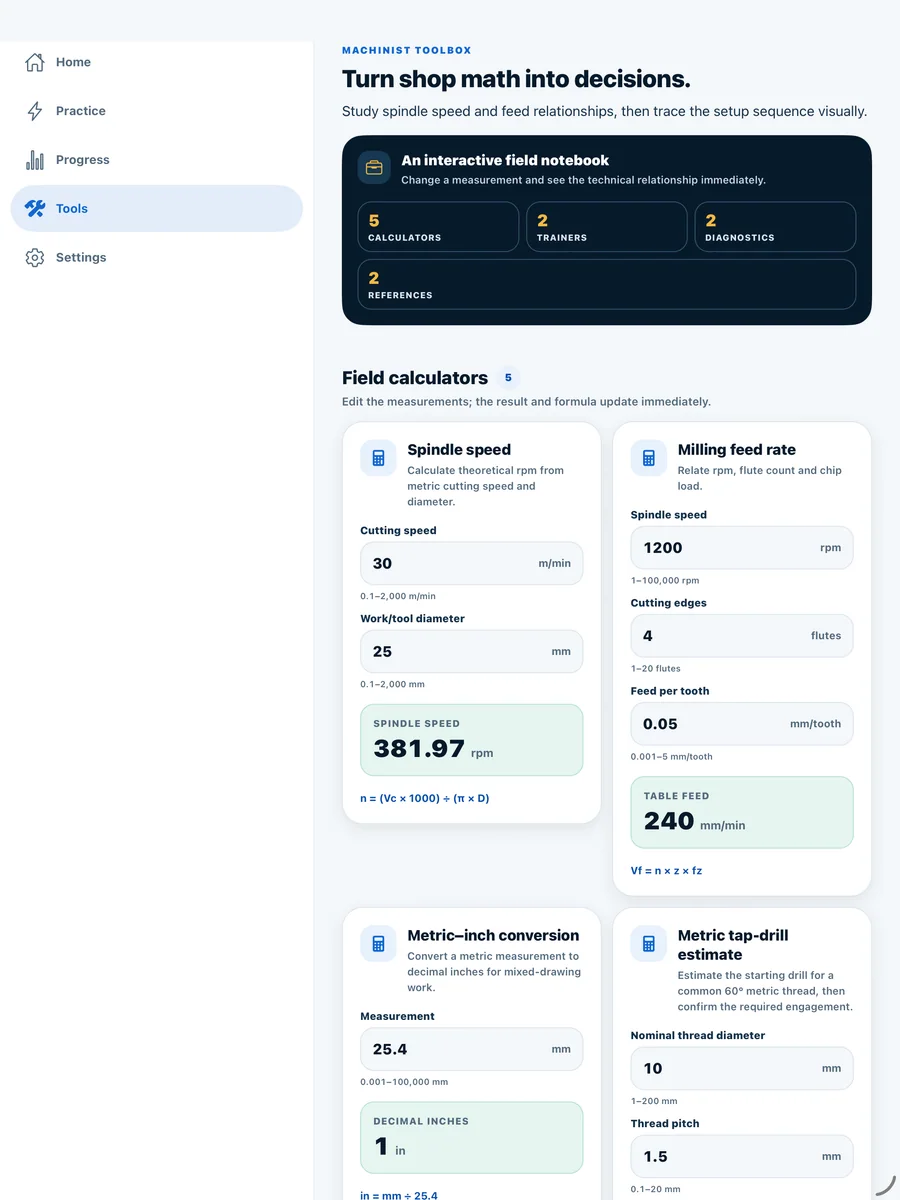
The app’s shop-math tools are paired with setup decisions so a number has a machining consequence.
- Extract the datum, tolerance, material and required finish from the print.
- Use speed, feed, thread, fit and conversion tools to establish the starting setup.
- Compare the measured result with the process and adjust the cause, not only the offset.
4. Turn your results into a seven-day cycle
- Day 1: diagnostic and weakness ranking.
- Days 2–4: targeted practice in the two weakest areas.
- Day 5: timed mixed set.
- Day 6: review errors and technical sources.
- Day 7: full mock or targeted review, then build the next plan.
5. Correct the mistakes that cost marks
- Using diameter where radius is required, or mixing millimetres, inches and surface-speed units.
- Choosing a cutting condition without accounting for material, rigidity, tool type and operation.
- Treating a CNC correction as an offset problem before checking workholding, tool geometry and program logic.
- Memorizing a finished dimension while ignoring datum structure and tolerance stack.
Red Seal endorsement vs Ontario 429A: what is the difference?
429A is Ontario’s trade code for General Machinist. It identifies the trade in Ontario’s apprenticeship and Certificate of Qualification system. The Red Seal endorsement is the interprovincial standard added to a provincial or territorial certificate after you pass the Red Seal exam, and it is recognised by the participating provinces and territories. Other provinces and territories use their own trade names and codes for the same Red Seal trade, so search by the Red Seal trade name for national resources and by the provincial code when you deal with your local authority.
Ontario trade profile (429A) · Official Red Seal trade page · All Ontario trade codes and licence status
Where to find Machinist exam questions and answers
Official Red Seal exam questions are not published, so any file sold as “real” Machinist exam questions cannot be verified. Three sources you can check:
- The official exam information page: a free self-assessment and examples of each question type.
- Our free practice test: 25 reviewed questions with answers and explanations, which you can print or save as PDF.
- The full Machinist Red Seal Exam Prep app: 1,500+ bilingual questions with explanations and timed mocks, on iPhone, iPad and Android.
Exam and study questions
What trade does Ontario code 429A identify?
429A is Ontario’s trade code for General Machinist. The provincial code identifies the trade; the Red Seal endorsement is interprovincial. Check eligibility, exam registration and certification requirements with Skilled Trades Ontario. This guide is an independent study aid.
How many questions are on the Machinist Red Seal exam?
The published allocation shown in this guide has 135 questions. The official preparation guide specifies four hours and a 70% passing mark. Check the official exam information and your exam confirmation before your sitting.
Where can I find free practice questions with answers?
Our free practice test has 25 reviewed questions with answers, explanations and references, in English or French, with no account; a timed 10-question browser demo draws from the same set. These are independent study questions, not official, confidential or recalled exam questions.
How should I use a mock exam to prepare?
Start with a short set, group mistakes by work area and review correct answers you guessed. Use the seven-day study plan above to organise revision. A full 135-question mock can then help with pacing; a 25-question set cannot predict whether you will pass.
Does this guide replace a course, textbook or Certificate of Qualification?
No. It helps organise study for the interprovincial Red Seal exam. Use your occupational standard, training materials and official exam information as well. Your provincial or territorial authority determines eligibility, registration, fees and rewrite requirements.
How hard is the Machinist Red Seal exam?
The official exam pages do not publish a pass rate. The exam has 135 multiple-choice questions in four hours with a 70% pass mark, and the official question-style mix puts most of the weight on procedural, application and critical-thinking questions rather than recall. Candidates find it hardest when they have not worked in every area of the standard or have not practised timed multiple-choice questions recently; the study plan in this guide addresses both.
What is the passing mark, and how long is the exam?
The official Red Seal exam preparation guide states a pass mark of 70% and a writing time of four hours. Each question has four choices with one correct answer. Confirm the details for your sitting on your exam confirmation.
Can I write the Red Seal exam in French?
Red Seal exams are offered in English and French. The official preparation guide asks candidates to confirm the exam language when they register, so tell your provincial or territorial authority which language you want. This guide and the free practice questions are available in both languages.
Is there a PDF of machinist practice questions with answers?
Yes, for our free set: open the free practice test, choose “Print or save as PDF”, and your browser saves the 25 questions with answers and explanations. The official Red Seal exam information page also offers a free self-assessment and examples of each question type. We do not sell or reproduce recalled exam questions; official exam questions are not published.
Your next study session
Choose a short scored practice set or work through calculations step by step.
What should you study for this trade?
Use these study prompts to explain your reasoning aloud or to a study partner. They complement the official exam breakdown above.
Measurement, tolerances and shop calculations
Write the required dimension and tolerance before calculating an adjustment. State whether the dial or offset represents radius or diameter, and keep metric and imperial units separate. In the examples below, compare the tap-drill approximation with the lathe and boring-head questions: each tests a different interpretation of a dimension.
Conventional machining and process selection
Choose a process from the workpiece material, shape, tolerance and required finish. Explain why a saw, drill press, lathe, mill or grinder fits the task, then consider setup and inspection. Build revision around complete operations, including benchwork, rather than studying only the machine you use most often.
CNC coordinates and setup reasoning
Sketch the work origin and axis directions before reading coordinates. Distinguish absolute positions from incremental moves, and explain the purpose of work and tool offsets in your own words. Check the result against the drawing. CNC practice belongs alongside conventional machining and measurement in a General Machinist study plan.
Free practice questions with answers
Questions from our public demo, created and reviewed with AI assistance. Answer before opening the explanation, then note the reason for any mistake or uncertain answer. These are independent study exercises, not official exam questions. For workplace tasks, verify the applicable procedures and technical sources.
Question 1 · Common occupational skills
After electrical isolation, a vertical machine axis still tends to descend. What must be addressed before work begins?
- Work quickly before the axis moves very far
- Place the control in incremental mode
- Rely on the servo brake because power is off
- Block or restrain the stored mechanical energy.
Show answer and explanation
Answer: D — Block or restrain the stored mechanical energy.
Electrical isolation does not remove potential energy from an elevated mass.
Question 2 · Benchwork
After a tang-driven insert is installed to the specified depth, what final step may be required before assembly?
- Fill the insert with grinding dust
- Remove the tang; verify insert position and thread.
- Pull the insert back out with the bolt
- Leave the tang for the fastener to break during assembly
Show answer and explanation
Answer: B — Remove the tang; verify insert position and thread.
A retained tang can obstruct a through fastener or contaminate the assembly.
Take the free 25-question test with scoring
Try all 25 free practice questions
Next: revisit topics where your reasoning is still uncertain, then compare the full app’s study features. Free demo and full app
How these resources are checked
These independent resources are written and reviewed with AI assistance. Public questions come only from the approved demo samples. Automated tests check option, answer and explanation associations in both languages; numerical tests check the worked calculations. Official sources support the exam information. These checks are not a technical review by a qualified tradesperson.
Found an error or ambiguous wording? Include the trade, language and question number in your message. Report a content issue
Official sources and limits
Last reviewed October 12, 2026. Check for changes before your exam.
- Official trade-specific exam information
- Ontario trade profile
- Official Red Seal trade page
- Official Red Seal exam preparation guide
Red Seal Ready Canada is an independent Certloom Learning study aid. It is not affiliated with or endorsed by the Red Seal Program. This guide does not replace your provincial or territorial authority’s rules and does not guarantee a passing result.
Free demo, full app and official study resources
Choose the resources that fit your next study session. The demo and app are independent study aids; use official sources for exam rules.
Try it free
25 reviewed bilingual questions for your trade, with answers and explanations, in your browser. No account. A timed 10-question demo drawn from the same set is also available.
Open the 25 free practice questionsStudy with the full app
1,500+ bilingual questions, 135-question mock exams, interactive trade exercises and offline progress tracking. Free download on iPhone, iPad and Android with 50 free questions; one C$19.99 in-app purchase unlocks the full app. No subscription.
Prices are shown in CAD. Applicable taxes may be added at checkout by the App Store or Google Play.

Check the official exam basis
Read the exam breakdown and Red Seal Program resources free of charge. Your provincial or territorial authority determines eligibility and registration.
Official exam informationTake the free 25-question practice test.
Questions with answers and explanations; a timed 10-question demo draws from the same set. Both are website-only, separate from the installed app, and your answers stay on your device.