
Heavy Duty Equipment Technician (HDET) Red Seal exam guide: format, pass mark and how to prepare
Use the official 135-question allocation to connect engines, electrical controls, drivetrains, fluid power and electrified equipment into one diagnostic study system.
The Heavy Duty Equipment Technician Red Seal exam is a multiple-choice exam with 135 questions, four answer choices per question, a four-hour time limit and a 70% pass mark. Provincial and territorial apprenticeship authorities register candidates and administer the exam; in Ontario the trade is called Heavy Duty Equipment Technician (421A).
Sources: official exam breakdown and Red Seal exam preparation guide, checked October 12, 2026.
Heavy Duty Equipment Technician practice test: 25 free questions, online or PDF · Heavy Duty Equipment Technician Red Seal exam prep app · Prep options compared
Ontario 421A · Heavy Duty Equipment Technician
Looking for heavy duty mechanic Red Seal exam prep, heavy equipment technician practice questions or HDET study help? This trade covers engines, electrical systems, drivetrains, hydraulics and equipment attachments. Ontario uses Heavy Duty Equipment Technician (421A). Heavy equipment operator and truck and transport mechanic are separate trades.
How hard is the Heavy Duty Equipment Technician Red Seal exam?
The official exam pages linked from this guide do not publish a pass rate, so treat any percentage quoted elsewhere as unverified. What you can plan for is the structure: 135 questions across 9 major work activities, with Electrical and electronic systems alone worth 25 questions (about 19%).
The official page currently describes about 5–15% knowledge and recall, 45–55% procedural and application, and 35–45% critical thinking. That makes diagnostic sequence, evidence and elimination especially important.
In practice, the exam is hardest for two groups: people who know their own specialty well but have not worked in every area of the standard, and experienced tradespeople who have not written a timed multiple-choice exam in years. Both are fixable with a short diagnostic, a plan weighted by work area and timed practice, which is what the steps below organise.
How to prepare for the Heavy Duty Equipment Technician exam: six steps
- Confirm eligibility, registration and the exam language with your provincial or territorial authority. Ontario trade profile (421A)
- Read the official exam breakdown and try the free self-assessment. Official exam information
- Take a short diagnostic: our free 25-question practice test with answers.
- Study by work-area weight, starting with your weakest large area. Breakdown and priorities
- Practise all three question styles, then follow the seven-day cycle. Question styles · Seven-day cycle
- Finish with timed full-length mocks and a mistake review. Mistakes that cost marks
1. Start with the official exam basis
The official page assigns 135 questions across nine major work activities and 41 tasks. It also publishes three question-style ranges and the acronyms provided at the sitting. Confirm the current page and your provincial or territorial authority before the exam.
Electrical/electronic systems and hydraulic, hydrostatic and pneumatic systems each carry 25 questions. Engines and drivetrain add another 37, but the exam also reaches environmental controls, structures and hybrid or all-electric equipment.
| Work area | Questions | Share |
|---|---|---|
| A. Common occupational skills | 10 | 7.4% |
| B. Engines and supporting systems | 20 | 14.8% |
| C. Steering, suspension, brakes and running gear | 16 | 11.9% |
| D. Electrical and electronic systems | 25 | 18.5% |
| E. Drivetrain systems | 17 | 12.6% |
| F. Environmental control systems | 9 | 6.7% |
| G. Hydraulic, hydrostatic and pneumatic systems | 25 | 18.5% |
| H. Structures, stations and attachments | 9 | 6.7% |
| I. Hybrid and all-electric equipment | 4 | 3.0% |
Formulas and reference material
The official preparation guide lists reference material and a calculator as provided when required. Review the trade-specific resources and confirm the instructions for your sitting with your provincial or territorial authority. Official resources for this trade · Exam supplies guidance
Priority: Build a symptom-to-system map before drilling into components. Alternate a high-weight diagnostic area with one smaller area so electrical and hydraulics do not crowd out brakes, HVAC, structures or high-voltage safety.
2. Practise all three question styles
The official page currently describes about 5–15% knowledge and recall, 45–55% procedural and application, and 35–45% critical thinking. That makes diagnostic sequence, evidence and elimination especially important.
- Identify the system boundary and the safest verification point before connecting a test instrument.
- Use voltage drop, pressure-flow relationships and schematics to choose the next test.
- Separate a command problem, supply problem, load problem and mechanical problem.
- Treat high-voltage isolation and verification as a procedure, not a vocabulary item.
3. Prove the failed system before opening the machine
The app’s diagnostic bay, electrical and hydraulic tools, and high-voltage trainer connect each reading to the next decision.
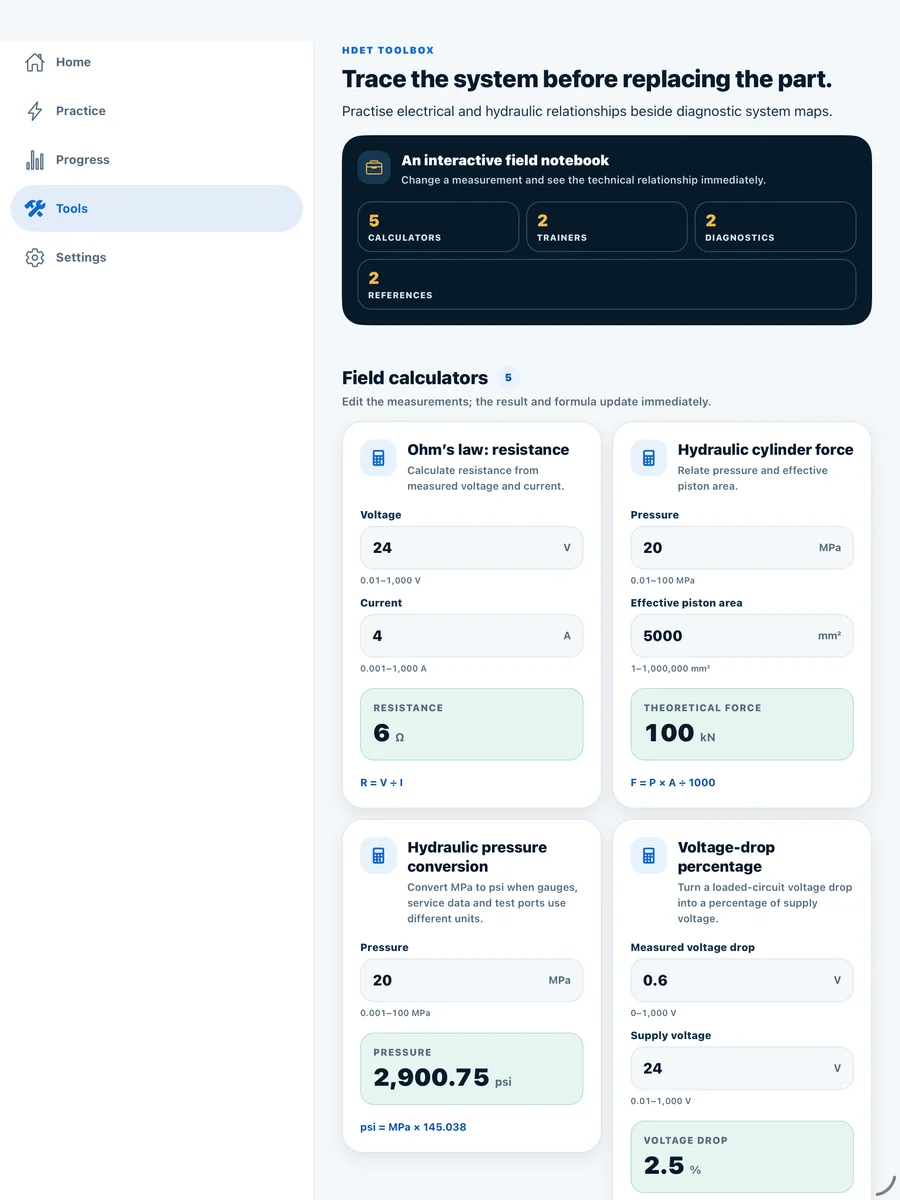
- Confirm the complaint, operating condition, stored information and safety boundary.
- Trace supply, command, load and return paths on the applicable schematic.
- Select one measurement that separates two causes, then update the fault tree from the result.
4. Turn your results into a seven-day cycle
- Day 1: diagnostic and weakness ranking.
- Days 2–4: targeted practice in the two weakest areas.
- Day 5: timed mixed set.
- Day 6: review errors and technical sources.
- Day 7: full mock or targeted review, then build the next plan.
5. Correct the mistakes that cost marks
- Replacing a component because of a fault code without proving the circuit or operating condition.
- Measuring voltage without loading the circuit or overlooking the return path.
- Interpreting hydraulic pressure without considering flow, restriction, load and temperature.
- Leaving hybrid and all-electric safety until the end because it has fewer questions.
Red Seal endorsement vs Ontario 421A: what is the difference?
421A is Ontario’s trade code for Heavy Duty Equipment Technician. It identifies the trade in Ontario’s apprenticeship and Certificate of Qualification system. The Red Seal endorsement is the interprovincial standard added to a provincial or territorial certificate after you pass the Red Seal exam, and it is recognised by the participating provinces and territories. Other provinces and territories use their own trade names and codes for the same Red Seal trade, so search by the Red Seal trade name for national resources and by the provincial code when you deal with your local authority.
Ontario trade profile (421A) · Official Red Seal trade page · All Ontario trade codes and licence status
Where to find Heavy Duty Equipment Technician exam questions and answers
Official Red Seal exam questions are not published, so any file sold as “real” Heavy Duty Equipment Technician exam questions cannot be verified. Three sources you can check:
- The official exam information page: a free self-assessment and examples of each question type.
- Our free practice test: 25 reviewed questions with answers and explanations, which you can print or save as PDF.
- The full Heavy Duty Mechanic Red Seal app: 1,500+ bilingual questions with explanations and timed mocks, on iPhone, iPad and Android.
Exam and study questions
What trade does Ontario code 421A identify?
421A is Ontario’s trade code for Heavy Duty Equipment Technician. The provincial code identifies the trade; the Red Seal endorsement is interprovincial. Check eligibility, exam registration and certification requirements with Skilled Trades Ontario. This guide is an independent study aid.
How many questions are on the Heavy Duty Equipment Technician Red Seal exam?
The published allocation shown in this guide has 135 questions. The official preparation guide specifies four hours and a 70% passing mark. Check the official exam information and your exam confirmation before your sitting.
Where can I find free practice questions with answers?
Our free practice test has 25 reviewed questions with answers, explanations and references, in English or French, with no account; a timed 10-question browser demo draws from the same set. These are independent study questions, not official, confidential or recalled exam questions.
How should I use a mock exam to prepare?
Start with a short set, group mistakes by work area and review correct answers you guessed. Use the seven-day study plan above to organise revision. A full 135-question mock can then help with pacing; a 25-question set cannot predict whether you will pass.
Does this guide replace a course, textbook or Certificate of Qualification?
No. It helps organise study for the interprovincial Red Seal exam. Use your occupational standard, training materials and official exam information as well. Your provincial or territorial authority determines eligibility, registration, fees and rewrite requirements.
How hard is the Heavy Duty Equipment Technician Red Seal exam?
The official exam pages do not publish a pass rate. The exam has 135 multiple-choice questions in four hours with a 70% pass mark, and the official question-style mix puts most of the weight on procedural, application and critical-thinking questions rather than recall. Candidates find it hardest when they have not worked in every area of the standard or have not practised timed multiple-choice questions recently; the study plan in this guide addresses both.
What is the passing mark, and how long is the exam?
The official Red Seal exam preparation guide states a pass mark of 70% and a writing time of four hours. Each question has four choices with one correct answer. Confirm the details for your sitting on your exam confirmation.
Can I write the Red Seal exam in French?
Red Seal exams are offered in English and French. The official preparation guide asks candidates to confirm the exam language when they register, so tell your provincial or territorial authority which language you want. This guide and the free practice questions are available in both languages.
Is there a PDF of heavy duty equipment technician practice questions with answers?
Yes, for our free set: open the free practice test, choose “Print or save as PDF”, and your browser saves the 25 questions with answers and explanations. The official Red Seal exam information page also offers a free self-assessment and examples of each question type. We do not sell or reproduce recalled exam questions; official exam questions are not published.
Your next study session
Try a short scored practice set with explanations.
What should you study for this trade?
Use these study prompts to explain your reasoning aloud or to a study partner. They complement the official exam breakdown above.
Engines, transmissions and repair verification
Study how you would confirm that a repair corrected the original complaint. Identify the operating condition, expected result and observation needed to verify it. Use the crankshaft and shift-rail examples below to practise choosing evidence of a successful repair rather than stopping when a component has been replaced.
Electrical controls and hydraulic systems
Separate the operator’s request, the controller’s command and the component’s actual response. Compare these with the circuit diagram before deciding where a fault lies. In hydraulic questions, record the operating conditions as well as the symptom; the cold-start filter example below makes that context part of the reasoning.
Structures, safety systems and electrified equipment
Keep structures, attachments and safety-related systems in the study plan alongside engines and hydraulics. Practise recognising when a proposed repair needs an approved procedure. Review hybrid and high-voltage terminology using the occupational standard and equipment documentation; online exam practice does not qualify someone to carry out high-voltage work.
Free practice questions with answers
Questions from our public demo, created and reviewed with AI assistance. Answer before opening the explanation, then note the reason for any mistake or uncertain answer. These are independent study exercises, not official exam questions. For workplace tasks, verify the applicable procedures and technical sources.
Question 1 · Common occupational skills
A technician observes that the repaired function works, but a disconnected warning lamp and a small fluid leak remain. Which test best distinguishes among the plausible causes?
- The procedure specifies this action: confirm the applicable publication through the manufacturer’s current service-information system
- The procedure specifies this action: verify the required thread condition and inspect the fasteners and joint surfaces for damage
- The procedure specifies this action: stop the release process and complete the safety, leak and warning-system checks
- The procedure specifies this action: inspect the races for installation marks and check runout and smoothness before operation
Show answer and explanation
Answer: C — The procedure specifies this action: stop the release process and complete the safety, leak and warning-system checks
The correct answer is “The procedure specifies this action: stop the release process and complete the safety, leak and warning-system checks”. This test directly addresses the evidence and best separates the plausible causes without speculative parts replacement.
Question 2 · Engines and supporting systems
After work on crankshaft thrust control, which observation confirms that the repair was successful?
- The repair is verified by this result: end play remains within specification through repeated clutch or converter operation
- The repair is verified by this result: cranking effort and compression return to the engine specification and the mechanism fully releases in the run position
- The repair is verified by this result: blow-by and oil consumption stabilize within specification after the prescribed break-in
- The repair is verified by this result: compression balance returns and the intake no longer shows leakage from that cylinder
Show answer and explanation
Answer: A — The repair is verified by this result: end play remains within specification through repeated clutch or converter operation
The correct answer is “The repair is verified by this result: end play remains within specification through repeated clutch or converter operation”. This result recreates the original operating condition and confirms performance rather than merely showing that a component was installed.
Take the free 25-question test with scoring
Try all 25 free practice questions
Next: revisit topics where your reasoning is still uncertain, then compare the full app’s study features. Free demo and full app
How these resources are checked
These independent resources are written and reviewed with AI assistance. Public questions come only from the approved demo samples. Automated tests check option, answer and explanation associations in both languages; numerical tests check the worked calculations. Official sources support the exam information. These checks are not a technical review by a qualified tradesperson.
Found an error or ambiguous wording? Include the trade, language and question number in your message. Report a content issue
Official sources and limits
Last reviewed October 12, 2026. Check for changes before your exam.
- Official trade-specific exam information
- Ontario trade profile
- Official Red Seal trade page
- Official Red Seal exam preparation guide
Red Seal Ready Canada is an independent Certloom Learning study aid. It is not affiliated with or endorsed by the Red Seal Program. This guide does not replace your provincial or territorial authority’s rules and does not guarantee a passing result.
Free demo, full app and official study resources
Choose the resources that fit your next study session. The demo and app are independent study aids; use official sources for exam rules.
Try it free
25 reviewed bilingual questions for your trade, with answers and explanations, in your browser. No account. A timed 10-question demo drawn from the same set is also available.
Open the 25 free practice questionsStudy with the full app
1,500+ bilingual questions, 135-question mock exams, interactive trade exercises and offline progress tracking. Free download on iPhone, iPad and Android with 50 free questions; one C$19.99 in-app purchase unlocks the full app. No subscription.
Prices are shown in CAD. Applicable taxes may be added at checkout by the App Store or Google Play.

Check the official exam basis
Read the exam breakdown and Red Seal Program resources free of charge. Your provincial or territorial authority determines eligibility and registration.
Official exam informationTake the free 25-question practice test.
Questions with answers and explanations; a timed 10-question demo draws from the same set. Both are website-only, separate from the installed app, and your answers stay on your device.